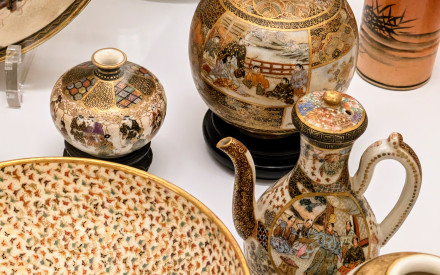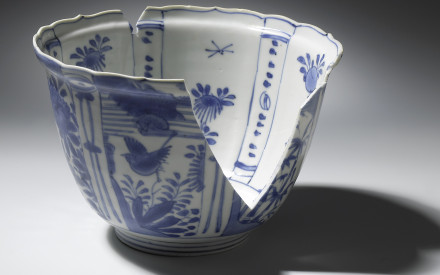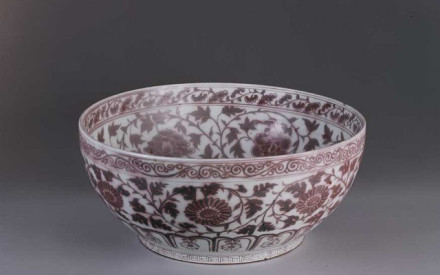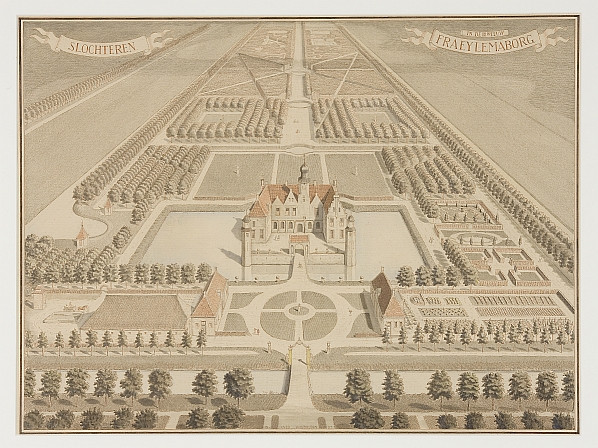
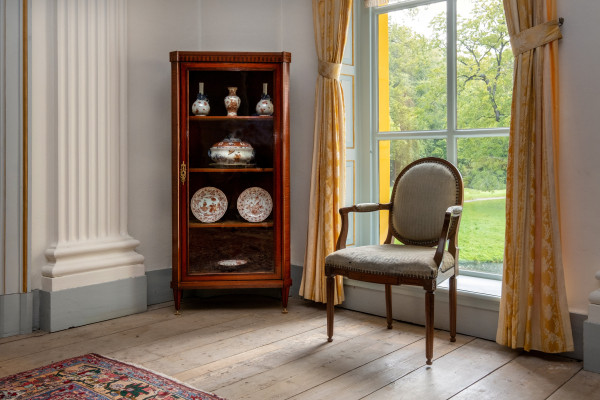
Asian porcelain continues to be well-represented in the centuries-old castles and country estates of the Netherlands (fig. 1). Surprisingly so, considering that these historical interiors came under considerable pressure during the twentieth century. This was certainly the case for the porcelain collection originally housed at the country estate Fraeylemaborg, located in the village of Slochteren in Groningen province.
In the seventeenth and eighteenth centuries, the situation was markedly different: a distinguished interior without Chinese and Japanese porcelain was almost unthinkable in the Dutch Republic. The heyday of the country estate - a luxurious (summer) residence away from the bustle of the city - coincided with the peak of the porcelain trade. Yet, while the appreciation for porcelain endured, many estates faced a different fate. Urbanisation, rising labour costs, and social changes led to sales and decline in the nineteenth and twentieth centuries, causing their associated historic collections to be dispersed.
In the twentieth century, awareness gradually grew that the ensemble of a historic house, garden, and interior deserved protection. Private occupation of these residences was often replaced by a museum function, allowing a number of historic interiors to survive. Yet even after this transition, these estates and their collections continued to evolve, as can be seen through the lens of the Fraeylemaborg estate.
Fraeylemaborg Estate
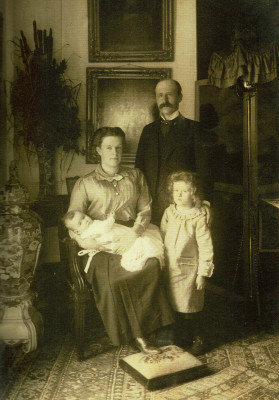
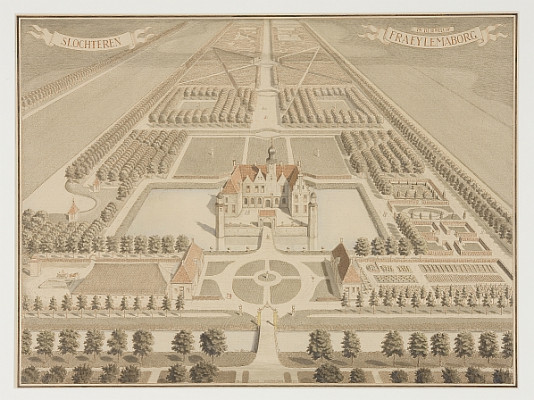
In 1971, the sisters Jeanne and Louise Thomassen à Thuessink van der Hoop van Slochteren (fig. 2) prepared to leave Fraeylemaborg, and did so with heavy hearts. The seven-hundred-year-old estate had belonged to the same family for almost two centuries. It comprised a woodland park with a coach house, farm buildings, greenhouses, and orchards (fig. 3). The family held on for as long as possible to a way of life shaped by the rights and obligations of landed privilege.
Eventually, however, this proved unsustainable: income from tenant farming and timber sales declined, while at the same time the costs of staff and maintenance continued to rise. In 1971, the sisters sold the household contents through a series of auctions, and a year later ownership and management of the estate and its park were transferred to the Gerrit van Houten Foundation.1 Following an extensive restoration, Fraeylemaborg reopened as a museum in 1975. The subsequent fifty years marked a new chapter for the estate, during which the collection was rebuilt through acquisitions, donations, and long-term loans
- 1The Gerrit van Houten Foundation was established in 1945 by the siblings of the painter Gerrit van Houten (1866-1934) to preserve his drawings, watercolours, and paintings, and to ensure continued attention for his work through active exhibition. With the acquisition of Fraeylemaborg, a permanent location was found in which to display his oeuvre.
Reassembling
The porcelain of Fraeylemaborg was sold in the 1971 auction (fig. 4). The sale included 59 lots (489 pieces) of ‘polychrome-decorated’ and 146 lots (626 pieces) of ‘blue-decorated’ Chinese and Japanese porcelain and earthenware. In addition, there were 53 lots of ‘European porcelain and earthenware’ and a mere 8 lots of Delft earthenware.
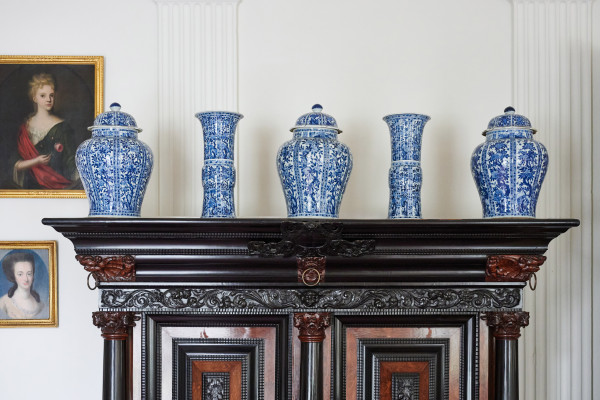
The historical significance of the interior was recognised at the time. Several Groningen-based foundations and museums purchased part of the furniture, paintings, and porcelain collection to secure their preservation. The J.B. Scholten Foundation acquired two Chinese blue-and-white garnitures from the Kangxi period (1662-1722), together with the cushion cupboard on which they originally stood (fig. 5). They were placed on long-term loan by the foundation to the newly opened museum, allowing them in 1975 to return to their original position in the Great Hall.
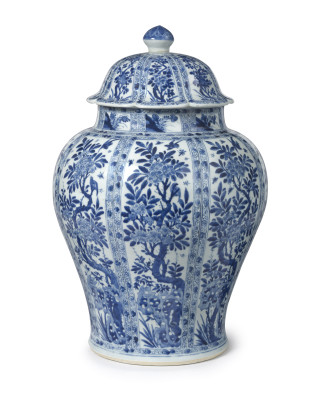
Both garnitures consist of three baluster-shaped covered jars and two tall beaker vases. They are characteristic examples of export porcelain made for the European market. It is nevertheless interesting to note that Queen Anna Pavlovna (1795-1865) owned a comparable covered jar, now in the collection of the Kunstmuseum Den Haag (fig. 6). This one, however, appears somewhat more regal in comparison: the painted flower decoration on the knob and the birds are more refined, and the spacing between the decorative panels is better balanced. Differences in quality are, of course, to be expected. Yet as a set of five, the garnitures at Fraeylemaborg are highly impressive; their gentle bulbous shape enhances the decoration in underglaze blue.
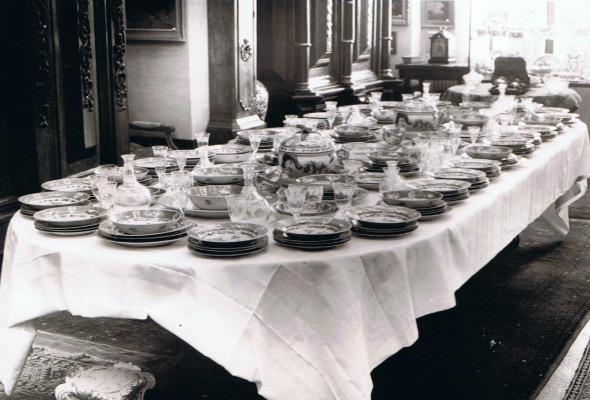
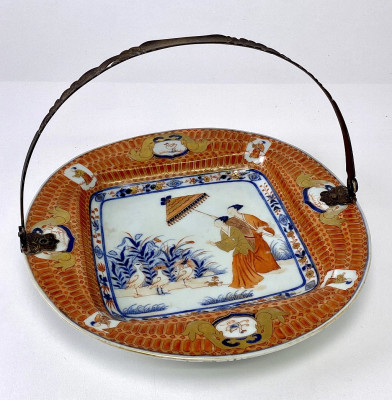
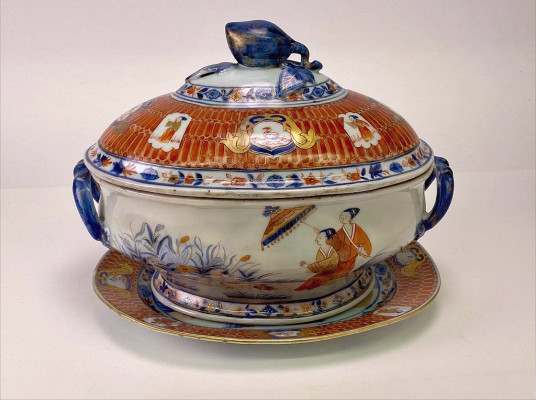
One of the highlights of the auction was an imposing 218-piece dinner service decorated with ‘the parasol ladies’, after a design by the Dutch artist Cornelis Pronk. The set was produced in China around 1735-1740 on commission for the VOC and reserved for special occasions. The household staff even received a bonus if nothing was broken during the washing-up. Unfortunately, however, the dinner service was dispersed and disappeared from public view following the auction. Today, only a single plate with an unusual square reserve (the brass handle is a later addition) and a tureen with cover and stand are part of the museum collection (figs. 7-8).1 A large European Saxon service, comprising 135 pieces, did remain with the family. Produced between 1760-1780 at the porcelain manufactory of Rudolstadt Volkstedt, it returned to Fraeylemaborg in 2013.2
A New Chapter in Collecting
Although the historic interior remained a priority, from 1975 onwards the period rooms at Fraeylemaborg were supplemented with long-term loans. During this period, the Groningen collector Jan Menze van Diepen (1905–1994) was searching for a venue in which to display his extensive collection of Asian ceramics and recognised an opportunity. In 1977 and 1982, the first exhibitions of Chinese and Japanese porcelain from his collection were held at Fraeylemaborg.
The close relationship between the Jan Menze Van Diepen Foundation, established in 1978, and Fraeylemaborg endured. Van Diepen was particularly fond of export wares, kraak porcelain, Transitional porcelain, and exuberantly polychrome ceramics, including Batavia Brown and Amsterdam Bont. A large part of the objects is included in the permanent display. In the catalogue of the collection Christiaan Jörg wrote: ‘Van Diepen loved abundance in decoration, the rich and lavish effect of ornament, and the elegance that a well-filled porcelain cabinet lent to an interior.’ By displaying his collection at Fraeylemaborg, van Diepen left a distinctive mark on the atmosphere of the estate.
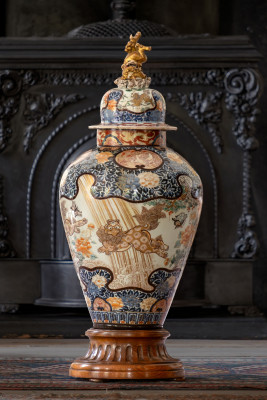
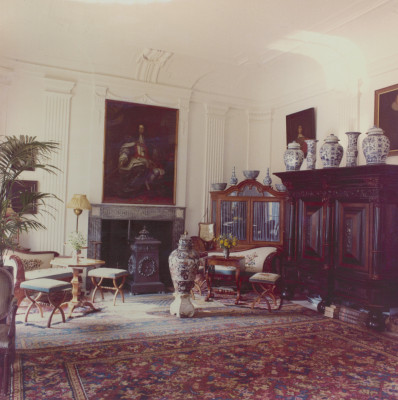
The Van Diepen Foundation continues to support acquisitions that enhance the presentation at Fraeylemaborg. In 2025, for example, a large Imari covered jar was acquired for the Great Hall (fig. 9). Historic photographs of the interior reveal that for decades a similar jar occupied a prominent position in front of the fireplace (fig. 10). In distinguished households, it was customary during the summer months to embellish an unused fireplace, for instance with porcelain. This original piece, unfortunately, disappeared from view after the 1971 auction. The acquisition of a comparable example brings visitors one step closer to experiencing the interior of the estate as it once was.
Throughout its history, the collection at Fraeylemaborg has been shaped by multiple generations, including additions of ceramics originating from various Groningen families: from the porcelain belonging to the eighteenth-century lord of the manor De Sandra Veldtman, to objects from the celebrated Sichterman collection and the Kangxi garniture of the Star Numan family. Future research in the Fraeylemaborg house archives - which have only recently become accessible - will hopefully provide further insight into the formation of the historic collection. Thus far, there are no indications of the obsessive collecting of porcelain by a single individual. This changed with the arrival of the Jan Menze van Diepen collection. By housing his collection at Fraeylemaborg, both the visibility and the diversity of porcelain within the interior were greatly enhanced. However, the essence of the aesthetic experience, so central to the country estate, has been preserved and is now accessible to a wider public.
Literature
Claartje Wesselink, ‘Collecties op drift. Over kastelen en kunst in Nederland’ and Henny van Harten, ‘Kan het nog maatschappelijker? in: Schitterende Ballast. Buitenplaatsen in de moderne wereld, 2024
Kunstveilingen Mak van Waay, catalogue 203, May 1971
Christiaan J.A. Jörg, Jan Menze van Diepen Stichting; A Selection from the collection of Oriental Ceramics , Slochteren, 2002
Henny van Harten-Boers, Allemaal voor het algemeen belang, verzamelaar Jan Menze van Diepen (1905-1994), Slochteren 2018