Dutch museums house a wide variety of Japanese ceramics produced in Arita on Kyushu Island, known as Imari and the more prestigious Kakiemon. This concerns predominantly large quantities of export porcelain, such as tableware and tea wares. The trade of this porcelain to Europe reached its peak from the late seventeenth to the eighteenth century. In the second half of the nineteenth century, however, a very different type of Japanese ceramic came to dominate the Western market: Satsuma. Remarkably, objects decorated in this style are almost entirely absent from the permanent displays of Dutch museums, and this ware has also received little attention in the scholarly literature.
The amount of Satsuma ware held in these museum collections is relatively modest, and there is generally limited knowledge on the provenance of these objects. Nevertheless, the Dutch collection in its entirety is of considerable art-historical value and offers a clear visual overview of the history of one of the most dynamic ceramic industries in nineteenth-century Japan.
Early development of Satsuma ceramics and Satsuma Kinrande
The origins of the ceramic industry in the Satsuma domain (present-day Kagoshima) date back to the late sixteenth century and are closely connected to the Japanese invasions of the Korean peninsula (1592-93; 1597-98) led by Toyotomi Hideyoshi (1537-1598). In the aftermath of these campaigns, daimyō (feudal lords) loyal to Toyotomi transferred Korean potter families to their own domains as prisoners of war, where they were employed in the production of ceramics. The Shimazu family, leaders of the Satsuma clan, dispersed the Korean population throughout the Satsuma domain. Potters were settled in several locations rich in natural resources, including Tateno, Naeshirogawa, Ryūmonji, Hirasa and Nishimochida. Soon after, a wide variety of wares was produced in these areas under what is now collectively referred to as ‘Satsuma ceramics’.
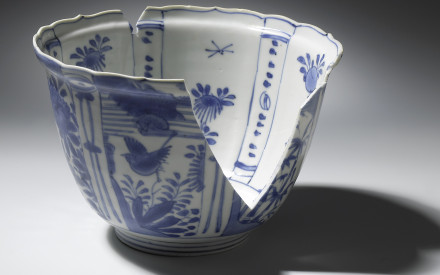
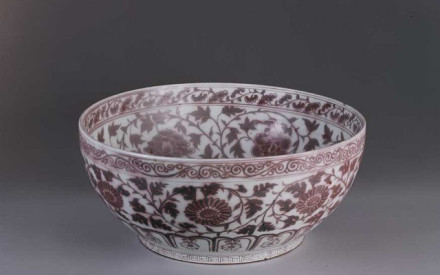
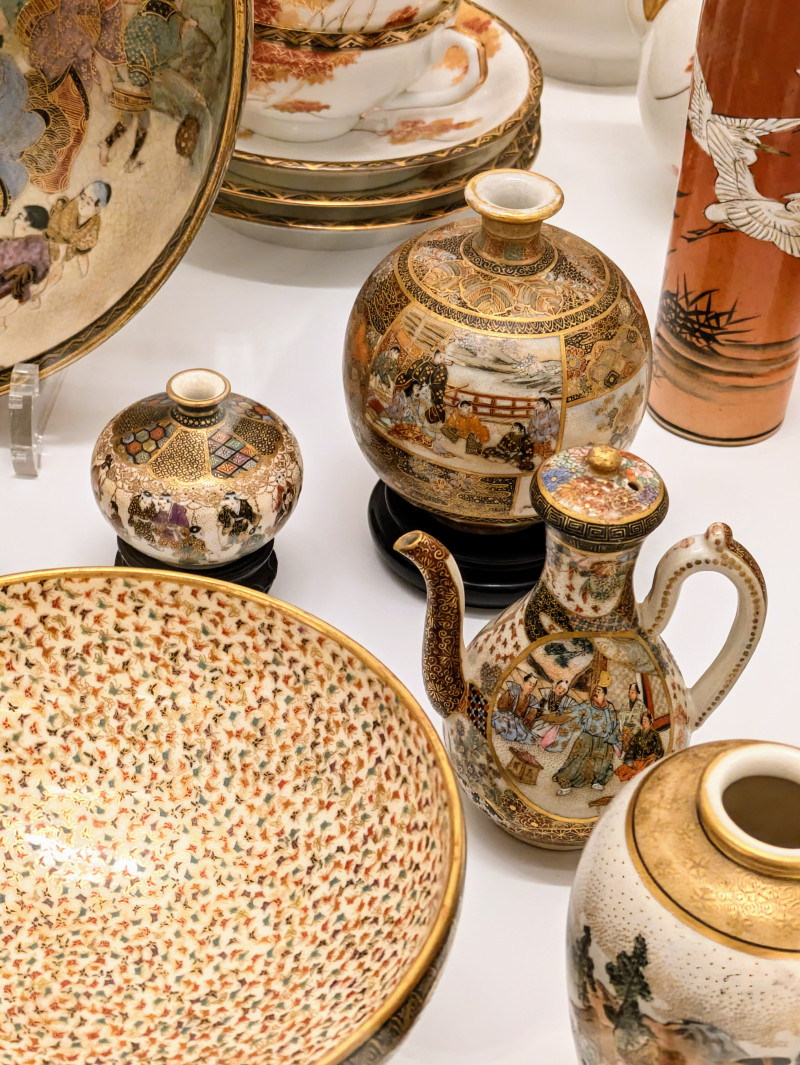
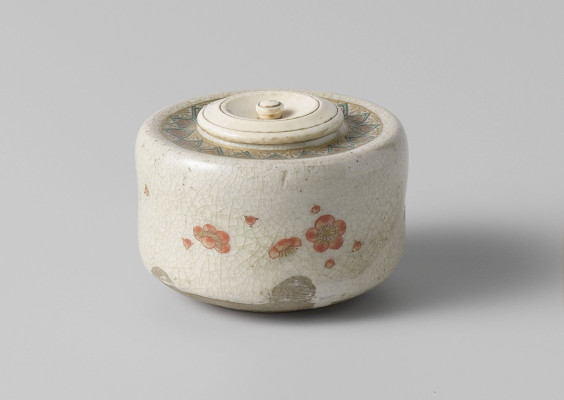
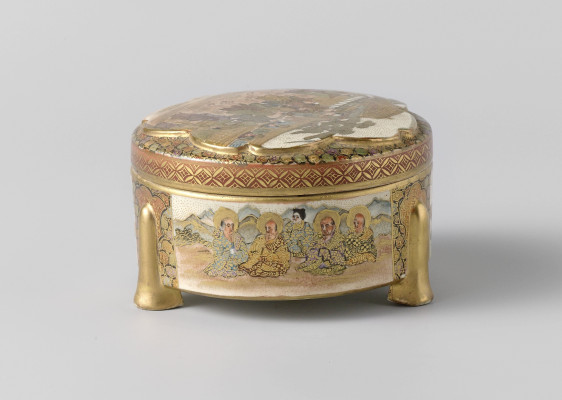
Satsuma ceramics are generally divided into two main groups: ‘black Satsuma’, dark-glazed earthenware intended for everyday use (fig. 1), and ‘white Satsuma’, ceramics with a creamy, crackled glaze originally inspired by Korean tea wares from the Joseon dynasty (1392–1910) (fig. 2). In the eighteenth century, the technique of enamelling (known in Japanese as nishikide) was introduced in this region from Kyoto, leading to the gradual embellishment of white Satsuma with gold and coloured enamels. This style became known as ‘Satsuma nishikide’, or more commonly ‘Satsuma kinrande’, a term referring to the dominant use of gold (fig. 3). In Japanese, the word kinrande literally means ‘gold’ or ‘brocade’.
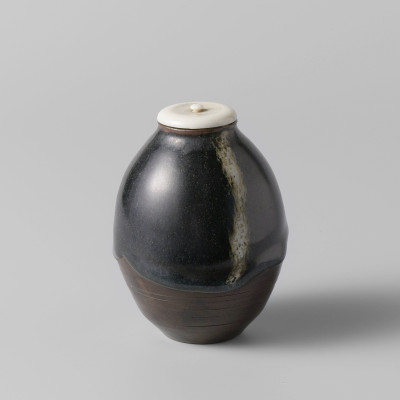
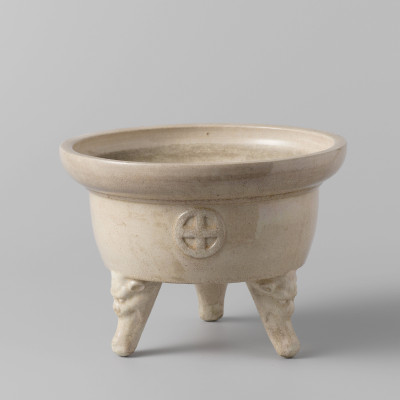
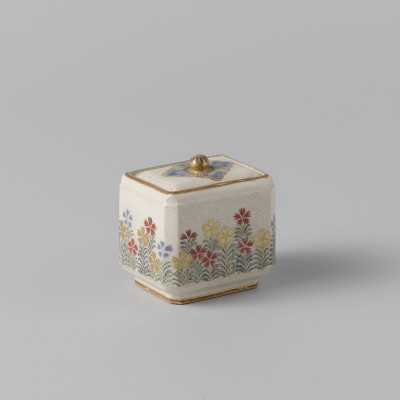
Originally, Satsuma ceramics were produced exclusively for the domestic market, with white Satsuma made solely for the feudal elite and therefore unavailable for public sale. In the nineteenth century, however, daimyō Shimazu Nariakira (1809–1858) brought about a significant change. Upon assuming power in 1851, he launched the Shuseikan project (1851–1915), which aimed to modernise the Japanese industry through the introduction of Western technology and factories. Nariakira recognised the export potential of Satsuma kinrande and lifted the restrictions on the sale of white Satsuma. In addition, he commissioned the construction of modern ceramic workshops where potters could experiment with Western enamelling techniques. As a result, both the scale of production and the quality of Satsuma kinrande improved considerably.
Satsuma export ceramics: a Western craze
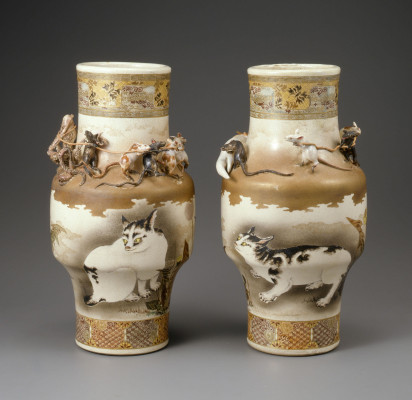
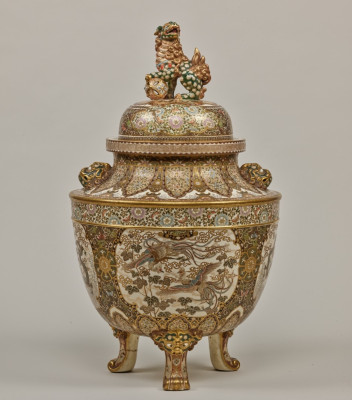
It was at the 1867 Exposition Universelle in Paris, the first world exhibition in which Japan officially participated, that Satsuma ceramics – especially the Kinrande type – were introduced to Western audiences. In both Europe and America, it turned out an immediate success. Art critics and historians praised ‘Satsuma’, as it became known in the West, as a pinnacle of Japanese craftsmanship, while also noting its Western aesthetic influences. The asymmetrical designs, vibrant enamel-and-gold compositions, and naturalistic decoration of Satsuma wares were perceived as a refreshing artistic impulse – one eagerly embraced by Western art lovers in the wake of the Industrial Revolution’s impact on art and craftsmanship. The enthusiasm intensified at subsequent world exhibitions, fuelled by the spectacular works on display by artists such as Chin Jukan (1835–1906), Kinkōzai Sōbei VII (1868–1927) and Miyagawa Kōzan (1842–1916) (figs. 4-5).
To meet the dramatic increase in demand for Satsuma kinrande, production spread beyond the Satsuma domain to metropolitan centres such as Yokohama, Kobe, Osaka and Kyoto. The term ‘Satsuma’ thus no longer referred to a type of ceramic produced in the Satsuma domain, but rather to a decorative style characterised by a creamy white crackled glaze and lavish embellishment in enamel and gold. It became a medium through which Japanese potters could experiment with the latest Western firing and decorative techniques. At the same time, it offered them a means to explore artistic freedom and to secure a position within an increasingly competitive market.
The enthusiasm for Satsuma ceramics in Europe and America, however, lasted only a few decades. The market was soon flooded with lower-quality wares, bringing an end to the romanticised Western image of Japan as a pre-industrial haven in which traditional craftsmanship still flourished. As the Satsuma market became saturated, many Japanese ceramic workshops were no longer able to survive, and successive generations of potter families no longer saw a future in this branch of the ceramic industry. The international economic crisis in the years following the First World War ultimately marked the definitive end of the Satsuma export industry, which had all but disappeared by around 1930.
Satsuma in the Dutch museum landscape
Despite the above-described significance of Satsuma ceramics in the history of Japanese ceramics and their role as a major export to Europe between 1870 and 1930, this ware became only marginally represented in the permanent displays of Dutch museums. What accounts for this limited presence?
Whereas Imari and Kakiemon porcelain were imported into the Netherlands in large quantities and widely imitated in the seventeenth and eighteenth centuries, Satsuma never achieved comparable prominence on the Dutch ceramics market. Did Satsuma—with its vivid colours and extensive use of gold decoration—fail to align with Dutch aesthetic preferences? This seems doubtful, given the substantial quantities of Satsuma still found in private collections, albeit strikingly often of low quality. Were the finer examples perhaps too expensive? Or did they simply not reach the Netherlands, as the principal trade in Satsuma ceramics passed through other European countries? To date, these questions remain unanswered.
It is noteworthy that the majority of Satsuma represented in Dutch museums derive from donations and bequests made by only a handful of collectors, in particular George Anders and Netty Bücher (the Anders Collection), Herman Karel and Betsy Westendorp-Osieck (the Westendorp-Osieck Collection), and Willem Jan Rust (the Rust Collection). What these collectors had in common was a broad, international approach to collecting East Asian art covering a wide range of periods, from antique Chinese and Japanese porcelain to more contemporary works. This shared outlook may help to explain the inclusion of Satsuma ceramics in their collections: the objects are of relatively high quality and were most likely acquired primarily abroad.

2019.1228
Nevertheless, the overall body of Satsuma ware held in Dutch museums should not be underestimated. It comprises around ninety objects distributed across the Wereldmuseum, the Rijksmuseum, the Princessehof National Museum of Ceramics, Museum Prinsenhof Delft, the Groninger Museum, and Kunstmuseum Den Haag. Altogether, these objects span the entire production period of Satsuma ceramics, ranging from the early wares of the seventeenth century to a wide variety of export Satsuma from the late nineteenth to early twentieth centuries. Together these objects provide a representative overview of Satsuma ceramics, showcasing variations in both high- and low-quality, the range of products made for different clients, the diversity of techniques employed, and the decorative elements that contributed to their popularity in Europe and America. What follows is an overview of several characteristic objects from these museum collections.
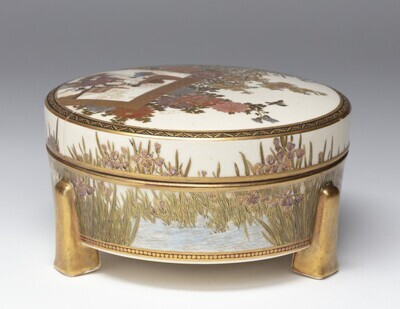
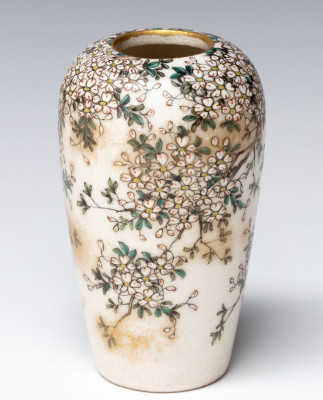
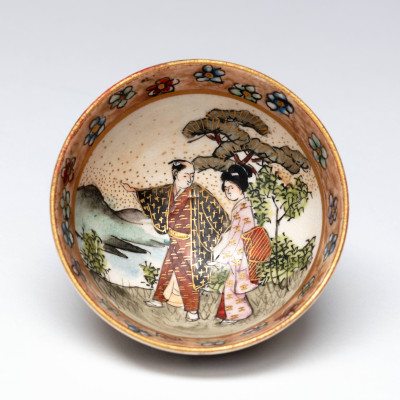
The Rijksmuseum houses a substantial collection of early Satsuma, ranging from black Satsuma tea caddies to white Satsuma and Satsuma kinrande (figs. 1-3). The tea caddy and bowl shown here illustrate how white Satsuma was gradually decorated with increasing amounts of enamel decoration (figs. 6-7). In the period 1880-1890, when the ware had passed its initial peak, the Satsuma market in the West became segmented into two principal groups: the general public, seeking a fashionable and recognisably Japanese product, and art collectors wishing to acquire masterworks. This division resulted in marked differences in quality, as demonstrated by two lidded boxes (figs. 8-9). The first example features an unrefined and excessive application of enamel and gold, lacking a coherent overall composition, whereas the second, with its fine yet restrained decoration, highlights the craftsmanship of its maker. Some ceramic workshops deliberately produced objects of widely varying quality to cater to all segments of the market, as illustrated by two objects produced at the workshop of Kinkōzan Sōbei VII (figs. 10-11). The miniature vase, with its minute detailing, was more likely intended for a discerning collector with an eye for quality, while the more hastily finished sake cup functioned primarily as a playful Japanese novelty.

2019.1229
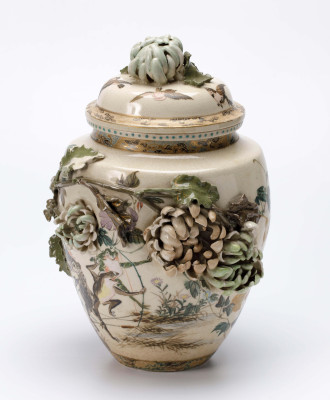
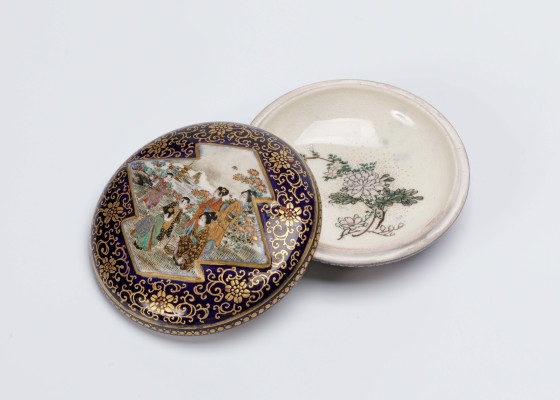
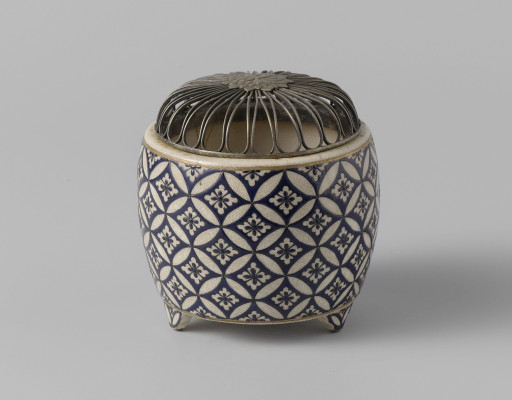
A lidded box and a charcoal burner from the Groninger Museum vividly demonstrate how Western techniques were integrated into Satsuma ceramics (figs. 12-13). The box’s blue ground recalls Rococo-style Sèvres porcelain, and the charcoal burner demonstrates the pâte-sur-pâte technique, where slip is applied to create relief decoration. At the same time, Japanese potters continued to experiment with their own techniques. They became known for combining decoration and form in unconventional ways, transforming functional objects into optical illusions and creating three-dimensional sculptures that appear to “grow” organically from the surface of the porcelain (figs. 14–15).
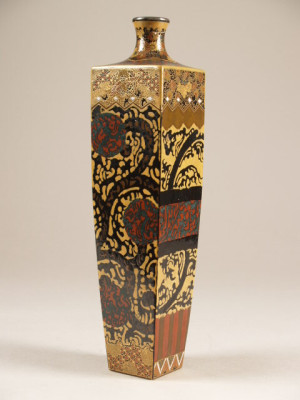
What made Satsuma kinrande particularly appealing in the West was its synthesis of Japanese and Western aesthetics. Two Art Nouveau-style vases in the Princessehof National Museum of Ceramics provide a striking example of this fusion (figs. 16-17). This artistic movement, itself inspired by Japonism and earlier Chinoiserie, in turn encouraged Japanese ceramicists to depict nature in a more stylised manner. The delicate natural motifs on these works recall the Romantic style of the late eighteenth and nineteenth centuries, while the flamboyant arabesques and gilded details evoke the eighteenth-century Rococo style.
The preceding examples demonstrate that the relatively modest, yet nonetheless substantial body of Satsuma objects held in Dutch museums merits further exploration. Although Satsuma export ceramics played only a limited role in the history of the Dutch ceramics market, their popularity in Europe and America should be understood within a broader context of artistic and industrial developments of the period. Moreover, Satsuma was undoubtedly one of the most dynamic export ceramic industries in nineteenth-century Japan and therefore deserves greater attention within the permanent collections of Dutch museums.
Literature
Satō Dōshi, Modern Japanese Art and the Meiji State: The Politics of Beauty, Los Angeles 2011.
Jan de Hond & Menno Fitski, De smalle brug: Japan en Nederland sinds 1600, Amsterdam 2016.
Gregory Irvine, ‘From Namban to Meiji: The Availability and Reception of Japanese Art in the West’, in: Irvine, Gregory (red.), Japonisme and the Rise of the Modern Art Movement: The Arts of the Meiji Period: The Khalili Collection, New York 2013.
Gisela Jahn & Michael Foster, Meiji Ceramics: The Art of Japanese Export Porcelain and Satsuma Ware 1868-1912, Stuttgart 2004.
Kiyomizu Museum of Art, SATSUMA: Kiyomizu Sannenzaka Bijutsukan Corekushon [SATSUMA: Kiyomizu Sannenzaka Museum Collectie], Kyoto 2015.
Louis Lawrence, Satsuma: Masterpieces from the World’s Important Collections, London 1991.
Clare Pollard, ‘Gorgeous with Glitter and Gold: Miyagawa Kōzan and the Role of Satsuma Export Ware in the Early Meiji Ceramic Industry’, in: Conant P. Ellen (red.), Challenging Past and Present: The Metamorphosis of Nineteenth-Century Japanese Art, Honolulu, Hawaii 2006, p. 133-150.
Satsuma-yaki Pari Dentō-bi-ten Jikkō Iinkai, Sakaishi hakubutsukan & Nihon keizai shinbun-sha, Satsuma- yaki: 400-nen no dentō to Pari wo miryō shita bi: Nichifutsu kōryū 150 shūnenkinen satsuma-yaki Pari dentō-bi-ten kaisai kinen-ten [Satsuma-keramiek: 400 jaar van traditie en schoonheid die Parijs betoverde: Ter herdenking van 150 jaar uitwisseling tussen Japan en Frankrijk], Osaka 2008.
Christine Shimizu, ‘La Céramique Japonaise et La Céramique de Satsuma’, In: Christine Shimizu & Hiroyuki Yamashita, Satsuma: De l’exotisme Au Japonisme, Parijs 2007 p. 20-24.
Jan Veenendaal & Titus Eliëns (red.), Asian Art and Dutch Taste, Den Haag 2014.
Hiroko Yokomizo, ‘The Presentation and Reception of Japanese Art in Europe during the Meiji Period’, in: Irvine, Gregory (red.), Japonisme and the rise of the modern art movement: the arts of the Meiji period: the Khalili collection, New York 2013.
Watanabe Yoshirō, ‘Satsuma-Yaki Kara SATSUMA e [Van Satsuma-keramiek naar SATSUMA]’, in: University of Zurich, Online International Symposium: Japanese Ceramics Brought to Switzerland, Zurich 1 januari 2022, p. 229-30.
Watanabe Yoshirō & Kumamoto Takashi, Nihon no yaki mo no kama betsu gaido: Satsuma (kama betsu gaido Nihon no yaki mono) [De gids voor Japans aardewerk: Satsuma], vol. 5, Kyoto 2003.