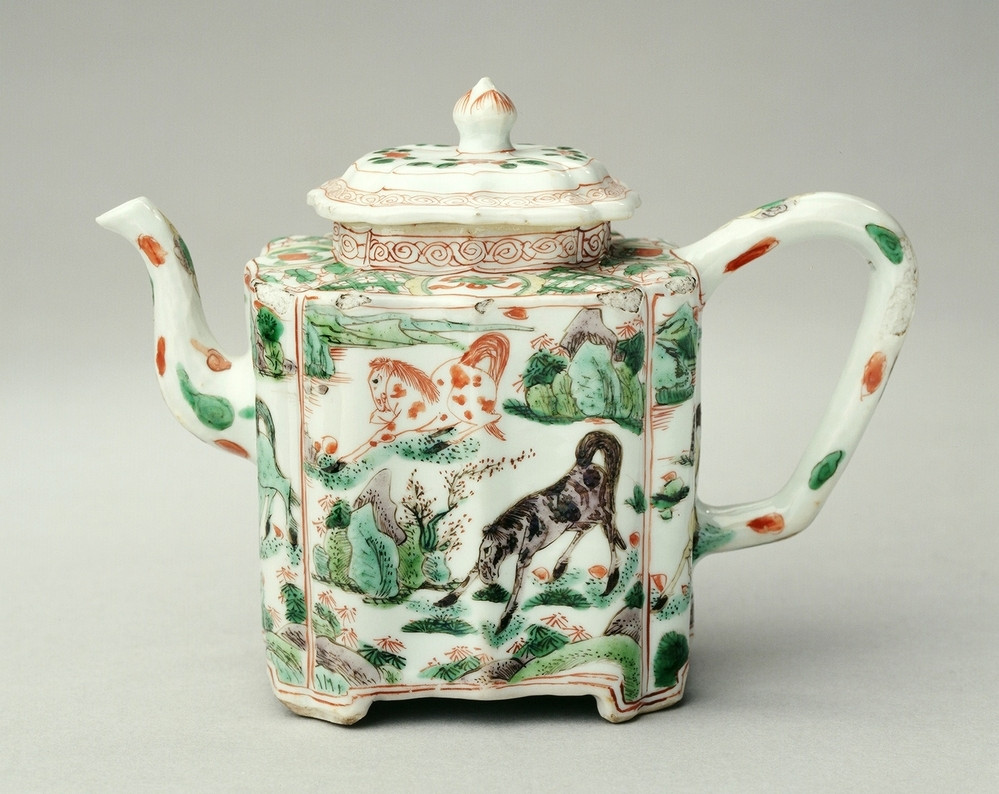
Vierkante theepot op vier platte overhoekse steunen, de recht oplopende wanden licht accolade-vormig en op de hoeken ingesnoerd, vlakke schouder, rechthoekige lage mondrand. Gelobd, laag gewelfd deksel met puntige knop. S-vormige tuit en C-vormig handvat. Famille verte, versierd in verschillende kleuren groen, geel, aubergine, ijzerrood en zwart email op het glazuur. Op elk van de vier kanten een landschap met twee paarden. Op de schouder bloem- en bladranken en kleine vakken met een gelukssymbool. Op de mondrand en dekselrand een spiraalband. De onderzijde is geglazuurd. Deze fraaie theepot past bij het in die tijd nog luxueuze theedrinken in Europa. Voor deze nieuwerwetse drank uit China was natuurlijk ook theegerei van porselein nodig, en de traditionele Chinese theepot in al zijn verschillende vormen werd zonder wijzigingen naar Europa verzonden. De paarden verbeelden de Acht Paarden van koning Mu Wang, die de dieren na een dienstbaar leven vrij in een wei liet lopen. Dit was zoiets ongehoords dat de daad vereeuwigd werd in de Chinese iconografie, waarbij er bijna altijd (maar niet op deze theepot) een paard van vreugde rollend op zijn rug wordt geschilderd.
Meer informatie
Pot
18e eeuw
Collectie
Jan Menze van Diepen Stichting
Beschrijving
Details
Datering
18e eeuw
Materiaal/techniek
gebakken
keramiek
Inventarisnummer
JMD-P-2375
Objectsoort