Ronde Zhangzhou doos met afgeplat-gewelfd deksel op lage voetring. Versierd in onderglazuur blauw. Centraal op het deksel een medaillon met een haas in wit op een blauwe grond. Rondom drie rennende paarden tussen zeewier; dezelfde versiering ook op het onderstuk. Gecraqueleerd glazuur. Zie voor commentaar cat. 22. Het motief van het rennende paard komt veel voor op laat-16e eeuws export porselein. Op deze doos is het gecombineerd met zeewier-vormen (op andere stukken met golfmotieven) en duidt daarom op het paard als een van de mythologische zee-creaturen. De haas is het vierde dier van de Chinese dierenriem en wordt geassocieerd met de maan, magie en onsterfelijkheid.
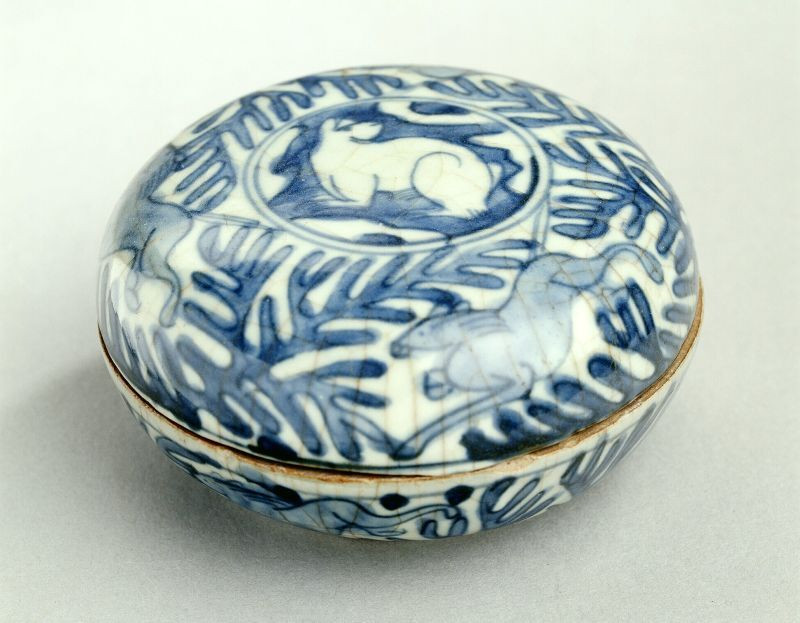
Round Zhangzhou box with flattened domed cover on low footring. Decorated in underglaze blue. In the centre of the cover a medallion with a white hare on a blue ground. Around it three galloping horses between seaweed motifs. The same decoration also appears on the lower part. Crackled glaze. For comments, see cat. 23. The motif of the galloping horse is common on export porcelain of the late 16th century. Here it has been combined with seaweed shapes (wave motifs on other pieces) and alludes to the horse as one of the mythical sea-creatures. The hare is the fourth animal of the Chinese zodiac and is associated with the moon, magic and immortality.
Round Swatow box with flattened domed cover on low footring. Decorated in underglaze blue. In the centre of the cover a medallion with a white hare on a blue ground. Around it three galloping horses between seaweed motifs. The same decoration also appears on the lower part. Crackled glaze. For comments, see cat. 23. The motif of the galloping horse is common on export porcelain of the late 16th century. Here it has been combined with seaweed shapes (wave motifs on other pieces) and alludes to the horse as one of the mythical sea-creatures. The hare is the fourth animal of the Chinese zodiac and is associated with the moon, magic and immortality.