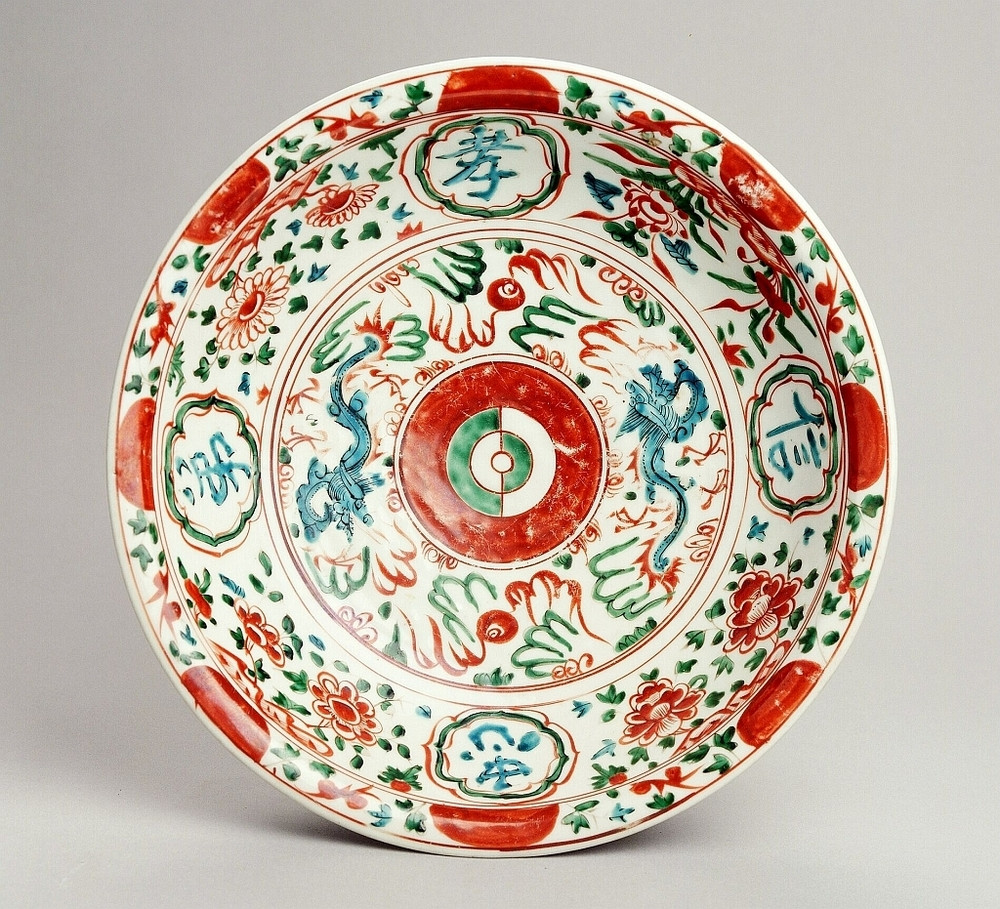
Zhangzhou dish on footring, narrow flat rim. Decorated in overglaze iron-red and two shades of green enamel. In the centre a variation on the Yin-Yang symbol surrounded by a red band. Around this two dragons chasing a flaming pearl between cloud motifs. On the sides four flower sprays (peony, chrysanthemum, lotus and another flower) separated by four panels containing the characters zhong, xin, xiao and di (the younger brother who honours his parents, is loyal and trusted). The rim with scrolls and red semicircles. On the outside three groups of red scrolls. Kiln-sand adhering to base. The semicircles are related to the red medallions on Wanli export porcelain for the south-east Asian market and Japan (see cat. 11{}), and this piece has been dated on that basis. The Yin-Yang symbol is extremely old and has an important function in Daoism. Yin (green) represents the feminine aspects–the mysterious, the earth and the moon, while Yang (white) represents the masculine aspects–heaven, the sun and light. Here they are inextricably entwined, thus forming the symbol of the Absolute (taiji). Another shape better known in the West is a circle divided into a darker and a lighter half by a...
Swatow dish on footring, narrow flat rim. Decorated in overglaze iron-red and two shades of green enamel. In the centre a variation on the Yin-Yang symbol surrounded by a red band. Around this two dragons chasing a flaming pearl between cloud motifs. On the sides four flower sprays (peony, chrysanthemum, lotus and another flower) separated by four panels containing the characters zhong, xin, xiao and di (the younger brother who honours his parents, is loyal and trusted). The rim with scrolls and red semicircles. On the outside three groups of red scrolls. Kiln-sand adhering to base. The semicircles are related to the red medallions on Wanli export porcelain for the south-east Asian market and Japan (see cat. 11{}), and this piece has been dated on that basis. The Yin-Yang symbol is extremely old and has an important function in Daoism. Yin (green) represents the feminine aspects–the mysterious, the earth and the moon, while Yang (white) represents the masculine aspects–heaven, the sun and light. Here they are inextricably entwined, thus forming the symbol of the Absolute (taiji). Another shape better known in the West is a circle divided into a darker and a lighter half by an S...