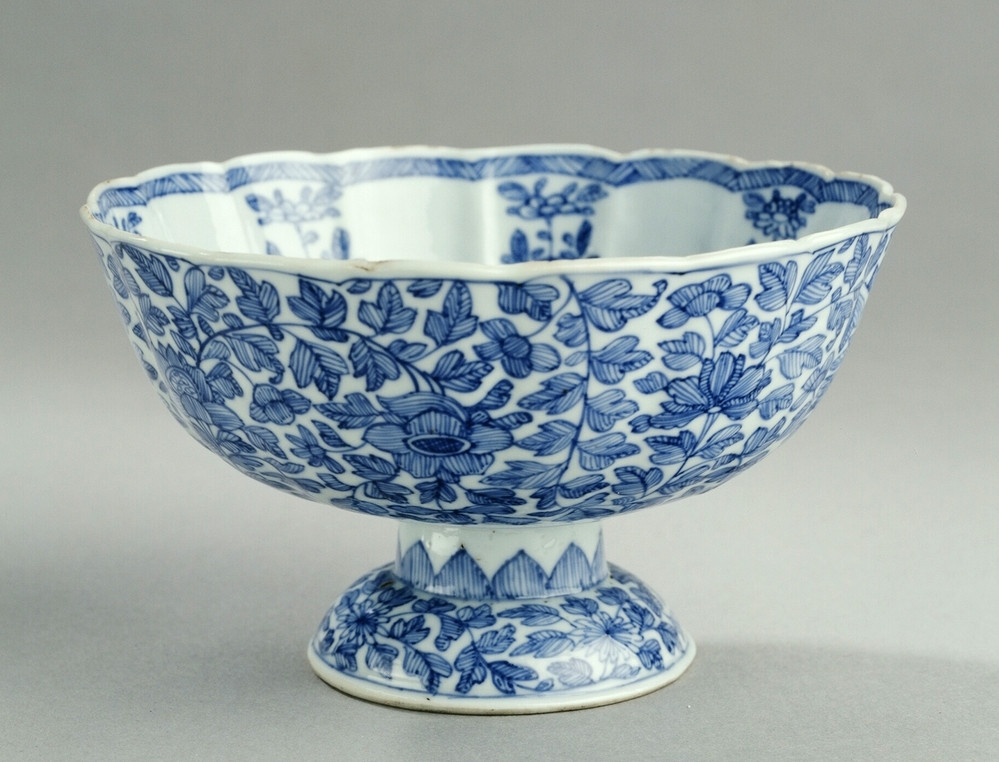
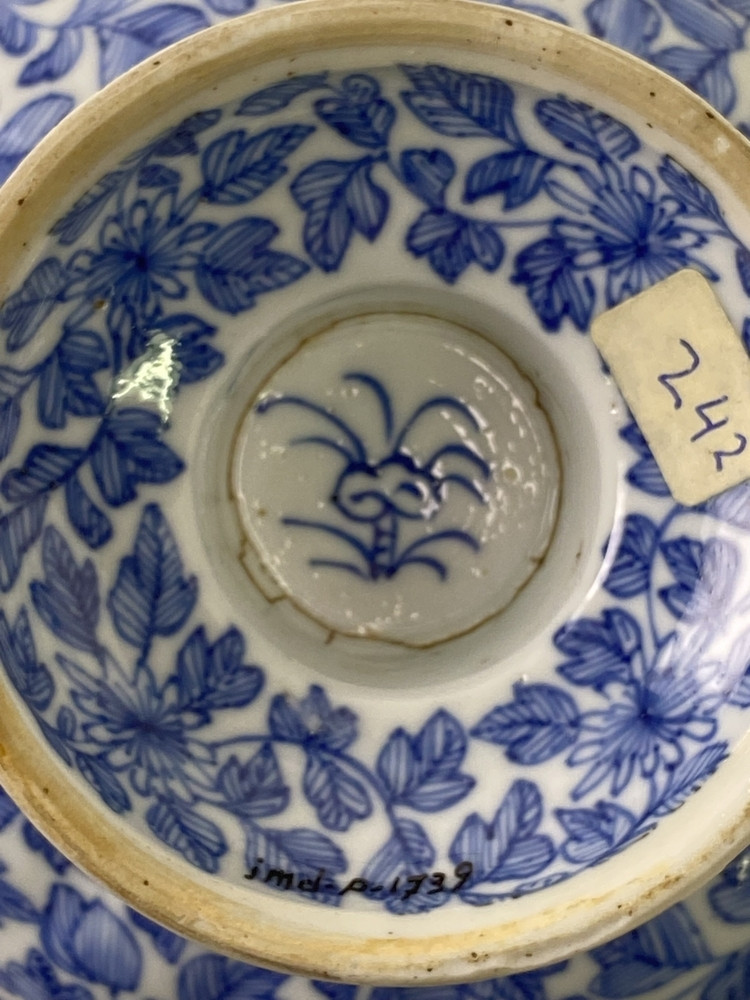
Tazza or bowl on tall foot. The hollow foot is formed by a domed base that supports a short, wide stem. On this the bowl-shaped, lobed upper part with a lobed rim. Decorated in underglaze blue with a pattern of flower and foliate sprays, including chrysanthemum and camellia painted in parallel lines. The same pattern on and inside the domed part of the foot. On the stem a band of half-leaves, the inside panels decorated alternately with and without a flower spray. Inside on the base the same pattern as on the outside within a circle surrounded by a zigzag band. On the base of the bowl, inside the attachment of the stem a fungus (lingzhi) mark. As the beaker, cat. 66, this shape also appears to be derived from a Chinese model, although in this instance, a European glass, metal or earthenware example may have served the purpose. Note the decorative style, whereby the contours are filled-in with thin, parallel lines and not with the usual brushed blue washes. A similar drawing, with a variation of hatching lines was frequently applied to blue-and-white export porcelain from c. 1690 to 1710, but not much thereafter. This style can sometimes be seen on kraak porcelain, notably on ke...
More information
Collectie
Jan Menze van Diepen Stichting
Beschrijving